
A Winter’s Haunt: Reviving the Victorian Tradition of Ghost Stories


Modern society experiences the holiday season as an extravagant display of bright lights, loud celebrations , and an ever-present sense of happiness through the use of LED lights and Christmas carols. We have taken the holiday season away from its roots and created a false sense of joy through our decoration of red and green with the idea of everlasting joy.
Historically, before electric light was invented, when the nights of winter were dark and cold with fierce wind blowing through the loopholes of the cold drafts of the chimneys, people gathered to tell of their holiday traditions, including the stories of reindeer who fly through the night sky. The stories told during this time were of those who had died.
For the Victorians, the ghost story was as essential to Christmas as the goose or the pudding. It was a ritual of the winter solstice, a recognition that in the midst of life, we are in death, and that the season of light is meaningless without the encroaching dark.
To read a ghost story at Christmas is to reclaim a lost heritage of storytelling, connecting us to a time when fear and wonder sat side by side at the hearth.
The Solstice and the Thinning Veil

Understanding why the spectre belongs at the feast requires looking back further than the Victorian period and understanding the pagan origins of the midwinter festival.
The Midwinter Festival was the time of year that celebrated the Winter Solstice as the death of the Year when the Sun is at its weakest and has no more crops harvested and the Earth is always encased in a thick, solid layer of Ice.
For centuries, this annual event has been considered the time in which the veil separating the living from the Dead becomes thinner, making it easier for the souls of the Dead to return to the realm of the living.
The ancients recognised the psychological impact that the long dark of Midwinter would have on all living creatures. Most people living in the past had no agricultural work to do during this season, and their tools were stored away until spring came. Therefore, everyone was forced to stay indoors during this time. The longing stillness in the air lets people wander off to faraway lands in their imagination and mentally into the unknown. The Yule tradition arose out of a need for people to attempt to explain their fears and anxieties due to the overwhelming loneliness, fearfulness, and uncertainty of the midwinter landscape.
When the Victorians adopted these traditions, they civilized the fear but kept the atmosphere. They understood that the ghost story is the perfect counterweight to the festive celebration. It provides a "pleasing terror", a controlled environment where one can experience fear while safely ensconced in warmth and company. The contrast is the key. The fire burns hotter when the story describes a freezing crypt; the company of friends feels more precious when the narrator speaks of isolation and doom.
The Architecture of Victorian Fear

The 19th century was the golden age of the ghost story, fueled by the rapid rise of periodical literature. Magazines like ‘ Household Words and All the Year Round’, often edited by Charles Dickens himself, released special "Christmas Numbers" that were eagerly anticipated by the public. These were not merely stories for children; they were complex narratives consumed by adults of all classes.
While Dickens is the most famous progenitor of this tradition with ‘A Christmas Carol’, his work was often more allegorical than terrifying. The ghosts of Scrooge’s past, present, and future were agents of morality, seeking to redeem a soul rather than merely haunt a house.
In order to understand how fear and horror were presented within the Victorian tradition, we will look for the true representation of the gothic tradition within those authors who approached the supernatural from an intrusion of the uncanny into the rational world, rather than as a means of sending a moral reference. The authors most successful at capturing this type of literary device were Elizabeth Gaskell, J. S. Le Fanu and later in time M. R. James with their development of the "quiet horror.”
Not only did Victorians see death as inevitable due to their own high mortality rates, ritualistic mourning customs and interest in Spiritualism, but they were also living in an era where death was an everyday part of life. All of these factors came together to create a culture in which people were constantly in communication with the beyond.
The Christmas ghost story provided an avenue for controlling death, as it brought the supernatural into the home and by doing so, it allowed readers to have some control over something that was otherwise uncontrollable.
The Scholarly Specters of M.R. James
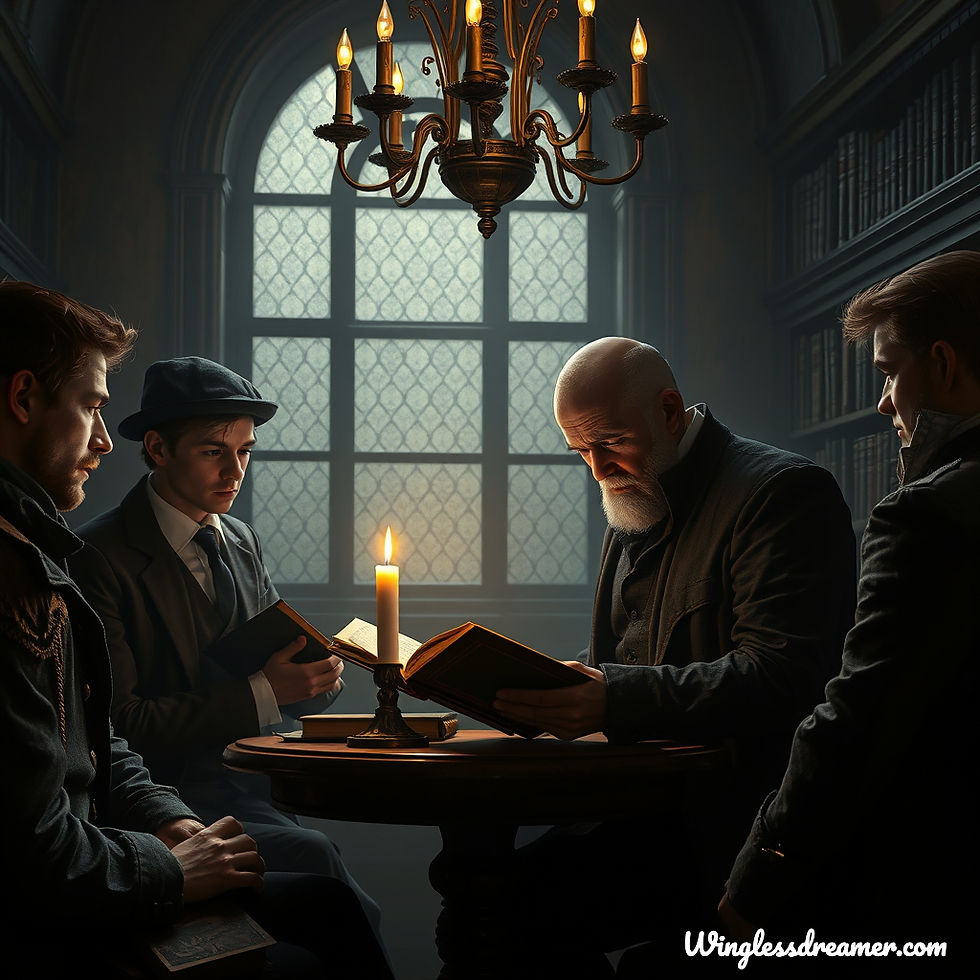
You must give Montague Rhodes James due credit as the ultimate authority on ghost stories set at Christmas. He was an expert on the Medieval period and a former Provost of King’s College, Cambridge. However, he was not writing for the general population. Rather, he wrote for his personal acquaintances.
For many years, he held an annual gathering on Christmas Eve when he would gather together some of his students and close friends in a room lit only by a single candle. There, in the dimly lit room, he would read from a handwritten manuscript that he had crafted specifically for that occasion.
James’s stories such as ‘The Mezzotint’ , ‘Oh, Whistle’, and ‘I’ll Come to You, My Lad ', and Canon Alberic’s Scrap-Book, remain the gold standard of the genre because they rely on atmosphere rather than gore. He understood that the most terrifying thing is not a monster jumping out of a closet, but a subtle alteration of reality.
A figure in a painting that moves slightly when you aren't looking. A texture of hair where there should be stone. A face on a sheet that has nobody beneath it.
James established the rules of the "antiquarian" ghost story. The setting was usually scholarly or historical. The protagonist is a rational man of science and the horror is something old, buried, and malevolent that has been disturbed. This formula resonates deeply with the winter aesthetic. It speaks to the idea that the past is never truly gone, only waiting beneath the snow for someone to uncover it.
Nostalgia and the Haunted Memory
Why do we, as modern readers and writers, yearn to return to this? Why does the idea of a "Christmas Ghost" feel so right, even if we grew up without the tradition?
Christmas is a time that is haunted. Christmas is a nostalgic time for us, the Christmas season being a constant comparison of what we have now vs what was before. For instance, we reflect back on all the Christmases that we experienced as children, which seem to have been made perfect by our memories. In addition to this, we are also reminded of and grieve for those loved ones that have passed away and who will no longer be at the table this year.
When families gather during Christmas and other holidays, they tend to include "ghosts," meaning the deceased grandparents who used to attend holiday gatherings. Ghosts are also our memories of friends who lived somewhere else, people we used to know, and our memories of ourselves as we once were, but who are no longer there.

The ghost story allows the person experiencing the haunting of memory to have a mental comparison between what is (the ghost) and what used to be (the memory). The ghost gives "life" to the memory by allowing it to have a narrative, or as some may say "story."
When we read a ghost story in December, we are engaging in a communal act of remembrance. We acknowledge that to be human is to be followed by the past. The Victorian ghost story validates the melancholy that often sits underneath the holiday cheer. It tells us that it is okay to feel the chill, that the shadows are a natural part of the light.
The Craft of the Winter Tale
For the writers and poets of the Wingless Dreamer community, the revival of this tradition offers a unique challenge. Writing a ghost story is an exercise in restraint. In an age of HD horror and jump scare cinema, the literary ghost stories require a different set of muscles.
To write a winter haunt is to focus on sensory deprivation. The best Victorian stories often take place in isolation. It can be in a snowbound train station, a lonely manor house or a deserted library. The writer must strip away the noise of the modern world to let the silence speak.
Consider the role of the uncanny. Freud defined the uncanny (or unheimlich) as something that is strangely familiar, yet unsettling. It is not the alien monster that scares us most; it is the doll that looks a little too much like a child, or the reflection in the mirror that is half a second slower than it should be. The goal is to make the reader question their own senses.
Furthermore, the setting acts as a character. In winter tales, the environment is often hostile. The cold is a physical presence, pressing against the windows, seeking entry. The architecture, the creaking floorboards, and the drafty corridors participate in the haunting. As writers, we must paint the atmosphere so thick that the reader feels the need to pull their blanket tighter.
A Call to the Fireside

The revival of the Christmas ghost story is not just about reading old books, but rather it is about reclaiming the way we experience stories. In our digital age, we consume content rapidly and often in isolation. The Victorian tradition was oral and communal. It required patience. It required a group of people willing to suspend their disbelief together in a darkened room.
This December, we invite you to turn down the lights. Step away from the blue glare of the screen and light a candle. Find a copy of M.R. James, Edith Wharton, or Charles Dickens. Better yet, write your own. Gather your friends or family, not to watch a movie, but to listen to a voice in the dark. There is a primitive magic in reading aloud while the wind batters the windowpane. It connects us to the thousands of generations who came before us, who sat in caves and huts and parlours, holding back the winter night with the power of words.
The ghosts are waiting. They have been waiting patiently in the library stacks and the antique shops, in the corners of our memory and the folklore of our ancestors. All they require is an invitation. Open the door this winter. Let the cold air in. Let the shadows lengthen. You might find that the fright is exactly what you needed to feel truly alive.
As we close the final chapter of this year, we stand on the threshold of a new narrative. The blank page of the coming year can be daunting, a story yet to be written, full of unknown twists and turns. But as we have learned from the masters of the ghost story, even the unknown holds a terrible beauty.
To the poets, the writers, and the dreamers of this community, do not fear the shadows in your work or in your lives. It is in the shadows that we find depth. It is in the silence that we find our voice. May your ink flow freely in the months to come. May your metaphors be sharp, your stanzas be strong, and your stories haunt the minds of your readers in the best possible way.
Happy New Year, Dreamers. Here’s to a 2026 filled with mystery, magic, and the courage to write your truth.
ABOUT THE BLOGGER

Meet Prarthana Binish, a history undergraduate lover who finds stories hidden in Delhi’s old streets and monuments. When she’s not exploring the past, she’s strumming her guitar, balancing the echoes of history with the rhythm of music.
Currently, she's working as an editor at Wingless Dreamer Publisher and has edited and published more than 10 anthologies. Way way to go!


Comments